
-
- Overstaying Your Welcome – The Age/Domain Article
See link to original article here
Words by Ellen Hill – 17/07/26
Overstaying your welcome
After unforeseen delays, you can risk still being in your sold home when the buyers arrive. Here’s when you legally need to be out.
You’ve sold the house, so when must you leave? While the answer varies by state, sellers generally have the legal right to remain in the property until settlement day, usually between 12pm and 3pm.
Banks typically spend the morning finalising the loan and repayments before settlement can proceed.
In NSW, buyers can issue a Notice to Complete, giving sellers 14 days to settle. If they don’t comply, the buyer can terminate the contract and retrieve their deposit or cause the settlement on the seller and complete the purchase and claim default interest pursuant to the terms of the contract.
In Queensland, buyers may seek damages or penalty interest payments if a seller causes a delay, while in Victoria, buyers can’t claim penalty interest but may terminate the contract after a 10-day delay.
Solicitor Sneha Chand from CJC Law Australia says sellers should aim to be out by the morning of settlement day.
“Once settlement has gone through, the property legally belongs to the new owners – the bank has paid the seller and the new owner has the title deeds,” she says. “If you remain in the property after settlement, technically you’re trespassing.”
Problems usually arise if sellers underestimate how long it will take them to move.
Jack Wimpey, a property partner at The Agency, says roughly one in five transactions now involves simultaneous settlements, where sellers buy and sell on the same day.
“That adds another layer of stress,” he says. “If something gets delayed, it has a ripple effect through removalists, finance and moving arrangements.”
While vendors may negotiate extensions for their move-out date, penalty rates will eventually kick in until the property is handed over, so delays can become expensive.
“Say you’ve sold the property for $2 million and there’s $1.8 million still owing,” Wimpey says. “At around 10 per cent per annum, that can work out to roughly $500 a day, every day you’re late.”
Buyers may also seek compensation for removalist delays, temporary accommodation or storage costs.
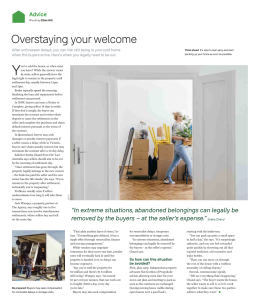
“In extreme situations, abandoned belongings can legally be removed by the buyers – at the seller’s expense,” Chand says.
So how can this situation be avoided?
First, plan early. Independent property advocate Nat Gordon of PROPOHOLIC advises allowing extra time for your move-out plan and starting to pack as soon as the contracts are exchanged (having moving boxes visible during open homes isn’t a good look), starting with the bathroom.
“You can pack up quite a small space in half a day,” she says. “It’s surprisingly cathartic, and you can feel rewarded quite quickly by throwing out all that expired medicine, old cosmetics and leaky bottles.
“Then you can move on through the rest of the house with a ruthless mentality of culling objects.”
Second, communicate openly.
“Tell me everything that’s happening,” Chand says. “The buyer wants the house, the seller wants to sell it, so let’s work together to make sure these two parties achieve what they want.”

